The demands of modern soccer competition require coaches to rethink their approach to training. The old linear and segmental way is not sufficient enough anymore. Unfortunately our Newtonian model of perceiving reality stands firmly in the way. We feel comfortable breaking down every process into smaller parts which we further label and divide.
It works flawlessly when it comes to building and designing mechanical structures and machines, but it falls short when applied to the human body and mind. Humans are not like your typical machines. We are much more complex. We are the creatures of habit and the more we repeat something, the more we refine it. We make specific neural connections each time we interact with our environment. To make a comparison to a machine, we are a special kind of machine which can reprogram itself constantly. If we make the same neural connection over and over again, it becomes automatic or subconscious if you will. Every time you decide to act, you try to retrieve the "hard wired" response, because it is refined and efficient, which means that you don't have to involve your mind on the conscious level. You simply take a shortcut. So how does it relate to training?
The goal of soccer training is to make soccer specific behavior automatic. The challenge of designing an effective training drill is to be able to replicate game-like intensity within the specific goal oriented exercise. You will not see Jose Mourinho or Pep Guardiola - who are among the most successful coaches in recent history - make their players run laps, or perform one dimensional, boring drills. If you want to be effective, you have to start with the goal in mind, and the goal is to emulate the real soccer experience with as many of it's aspects as possible. To make it work, one needs to create stimulating environment within the structure of the drill or scrimmage. The good example of this type of exercise is "The Rondo".
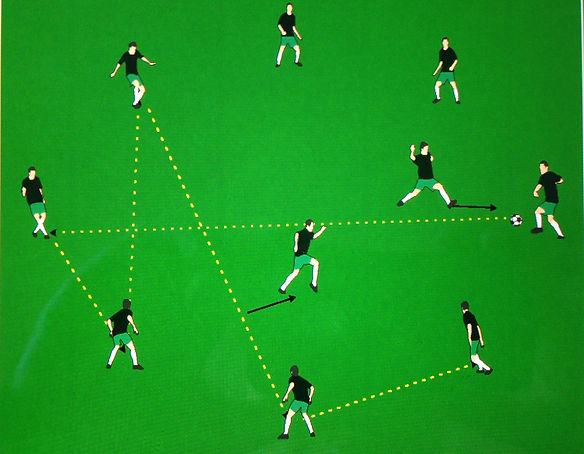
It is high intensity possession based practice drill where players form circle around 1,2 or 3 central players who aim to intercept passes or pressure the players positioned on the outside. The outside players attempt to retain both possession and the circular shape during play and demonstrate their ability to play intelligent short passes through their speed of thought and body positioning. The coach can limit the number of touches on the ball allowed to increase the speed of thinking and the exercise itself. The size of space and number of players can be modified as well to better replicate essential elements of the real game. Additional elements can be introduced, including scoring points by reaching a certain number of consecutive passes. This particular drill is a great example of a multidimensional stimulation of a soccer player where simultaneously the speed of play, creativity, decision making, team positioning, cooperation, concentration and physical conditioning are being emphasized. Implementation of this type of holistic approach to soccer training should be the priority for a modern coach.
Soccer training- the holistic approach