The landscape was bleak, rumors would fly back and forth as if being grunted through thick fog by the Serena Williams. January would arrive and the discussion boards were abuzz with results from meets as far flung as Cork, Mt Sac, Prague, Zurich and Weltklasse. The mental images of idols, with abilities rivaling the gods, grew like William Wallace with each new record scare. A worldwide game of Marco Polo would then commence. Having all the furor of a grass roots independently funded, worldwide NSA trying to find footage, however grainy, from however far away and whatever angle, of these great feats. For months the internet would be scoured worldwide with thousands hoping to be the one to deliver the goods to the throwing community. Hoping the footage would betray THE secret of throwing. One would announce on a discussion board “I found it!”, post a link (and hope that link worked), sit back and collect their kudos on a job well done. Mac throw video, was a shining light in the darkness….then came Youtube…
The first throwing video I ever watched was Brian Oldfield’s when I was a freshman in HS. 1997 in coach Berkheimer’s science classroom, I watched a 30 minute video of some of the largest fastest moving people I had ever seen. Things were moving so fast and going so far, picking out technical details wasn’t even a concern. I was completely overtaken by the “wow-factor”. When I arrived at Kent State and realized that throwing videos were good for more than gawking at, I began to develop a serious obsession with watching throwing videos, that I still suffer from today. Before Youtube it was hard to find linear progression, technically and performance wise, of any athlete. If one were so inclined they could do a mass search of results taking up hours of time, and no one wanted to do that, and even so, where would you find the stats of Ralph Rose, Ben Plunkett, or Seppo Raty?
One of the things I learned from Coach Fanger was that every far thrower did ostensibly the same things very well, and very consistently. The trick was to wade through the “personal styles” and get down to the meat of the throw. The Andy Bloom deep bow, the Anthony Washington lean, the Jan Zelezny wrap or the Balazs Kiss impossibly deep catches. All of that is wrapping paper. The trick was finding the things different successful athletes in the same events did the same, and then you’d have a starting point. That became easier with youtube, now you could track an individual’s evolution into a successful thrower, charting the changes and improvements. As my fascination with physics has grown I have begun to notice that not only can you cross reference a group of athletes successes in the same events, but in different events of similar physical makeup. That being projectile physics. I exclude Hammer and weight from this cross reference as their physics are more astrophysics than earth bound physics.
The projectile motion of which I speak is that of a bow and arrow. One of the societal game changers that allowed Ghengis Khan to found the mongol empire, the largest empire in world history. The power in the Bow lies in its huge store of potential energy, the tension of the bowstring has little to do with how far and fast the arrow travels. The launch of an arrow has mostly to do with the deformation of the bow by pulling the string, this builds potential energy. The energy the bow releases on its way back to equilibrium that pull the bowstring taught, transfers to the arrow or projectile.
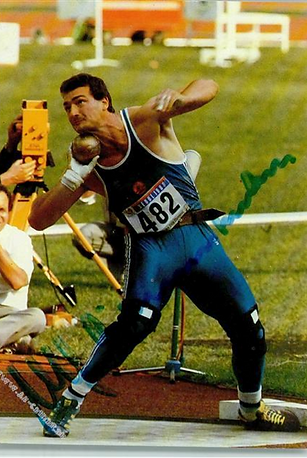
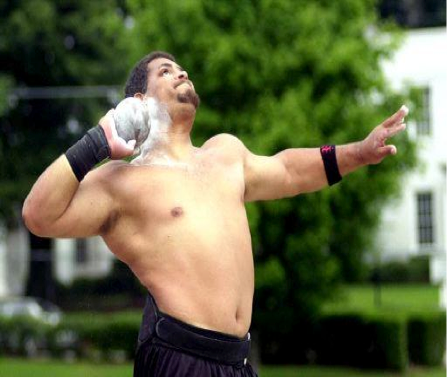
The first position I learned about in high school was the power, a properly thrown power throw had an “inverted C” position at the front of the circle. This is the hips out, arched back, staying behind the ball-patient position.
I learned it well and it quickly became one of, if not the only thing that i did consistently well as a high schooler. It is my belief that even though this position is incredibly important it has been marginalized in favor of more technical coaching points, my focus of bow and arrow physics is to demonstrate how integral this position is to throwing, and the body movements associated with it.
In the example of a shotputter/discus thrower the coaching point was always focused on getting the hip ahead of the implement, dragging the upper-body and implement forward creating separation and torque, if done properly without rushing the upper-body this position creates the “inverted C” position. I have always taught a vertical element to the ending of a shot put or discus throw as an advanced technique, if taught too early an athlete will favor the vertical aspects because it feels more powerful but without the rotational aspect they lose release velocity. As you can see by the picture below the rate of acceleration in the projectile (arrow) has a direct correlation with the amount of deformation in the bow.
Now in throwing there is a lack of a bow string, the part that allows the user to deform the bow. I believe that in throwing compression takes the place of the bow string. In the “inverted C” position if proper relaxation and separation are obtained the downward force created by the pivoting foot can create a compression effect causing extra force upon release.
I first observed this by a youtube video of Mac Wilkins in slow motion that immediately became my favorite throwing video to watch. Seen here:
when watched from :11 to :13 you can see the distortion in his body at the moment of release. Newtons 3rd law of motion states that every action has an equal and opposite reaction, meaning that the force directed downwards by Wilkins right foot creates return force from the earth into the release of the throw. With the elasticity of his torso this creates a bow effect creating, with the momentum conserved from his technical progression from the entry of the throw, accelerates the implement further without a forceful muscular contraction.
This vertical element can also be seen in the javelin seen here from :50 to 1:00.
The elasticity and stretch of the abs and torso acts as the pivot point the shoulder and lower body deform and regroup around, the faster this motion happens the more energy is sent to the implement.Where as the stabilizing force in a bow and arrow is the person holding the bow, the stabilizing force in the thrower system is the action of the block which has to be perfectly timed and forceful, allowing the pivot and downward force to take place over a long period of time without the power leaking out of the system.
In this compression action the rotation must be sustained and accelerated by the pivoting foot, while the downward force is created. This can be a very challenging concept and one that requires a great deal of timing and practice, but a concept that can add a great deal of distance in the rotational shot put technique. One of my now former collegiates increased his Pr by .60cm, by working the concepts of just the block and compression, in around 7 months time. I am trying to make a habit out of simplifying throwing, which I count as a coaching lack of mine, but I also believe you cannot “dumb down” these events. The goal is to communicate simplistically, very complex motions and thoughts.